
Highly sensitive children · Zen Books
The child who notices everything
They cry at birthday parties, get worn out at break time, ask things you didn’t expect at their age. They aren’t a weak child or a spoilt child. They are a child who perceives more, and that changes what they need from you.
Christian Duarte · Molecular biologist and science writer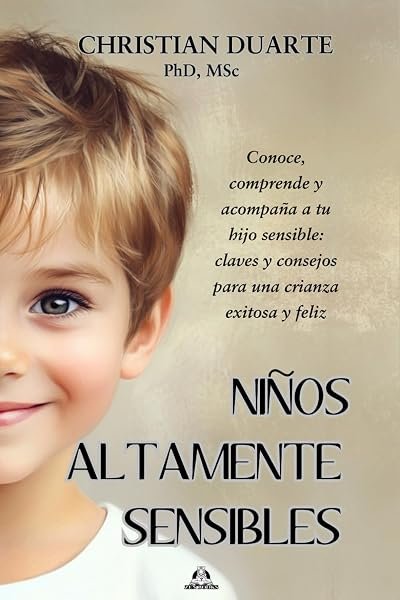
How to recognise it
Signs, not symptoms
None of these signs means anything on its own. Almost every child shows one of them, some day. What points the way is the whole picture and, above all, consistency: if you recognise your child in most of them, and they have been like this since they were very small, we are probably talking about the trait.
- Startles at noises that don’t bother others.
- Clothing labels, sock seams or an itchy garment ruin their day.
- Notices if you have been crying, even after you’ve washed your face.
- Prefers playing with one or two children rather than a big group.
- Asks deep or awkward questions for their age.
- Takes a while to go into new places, and then stays.
- Is deeply affected by teasing, telling-offs or sad films.
- Falls apart at the end of a good day: the birthday party, the school trip, Christmas.
- Performs worse when watched, even when they know the answer.
- Notices tiny details: a piece of furniture moved, a haircut, a tone of voice.
- Finds it hard to fall asleep after a busy day.
- Has a strong sense of fairness, and has had it from early on.
This isn’t a test or a diagnosis, and it doesn’t claim to be. There are validated questionnaires for measuring the trait in children, and researchers and clinicians use them. If something you see genuinely worries you, what is called for is a professional, not a list on a website.
What the research says
Three findings that change the conversation
The idea that sensitivity is a disadvantage comes from looking at only half the picture. Look at the whole of it and something else appears: these children respond more to their environment, for better and for worse. That makes them more vulnerable in a harsh home, and better off in a calm one.
There aren’t two groups, there are three
For years people spoke of sensitive and not sensitive. When several large samples of children and adults were analysed, three groups appeared: about three in ten are low in sensitivity, four in ten are in the middle and about three in ten are highly sensitive. The authors called them dandelions, tulips and orchids, and the name stuck.
A dandelion grows in any crack. An orchid needs conditions, and when it has them it produces a flower a dandelion never will. Neither is the better plant.
Boyce et al.
The same children, at both extremes
Ninety-nine nursery-age children were followed, measuring their biological reactivity to stress and how many respiratory infections they had. The most reactive, in high-stress families, fell ill more than anyone. The same children, in calm families, were the healthiest in the whole sample.
The low-reactive children fell ill just as often in one setting as in the other. The environment barely moved the needle for them. For the sensitive ones it moved it all the way, downwards and upwards.
Pluess and Boniwell, 2015
Which is why what you do counts for more
In a poor borough in east London, a twelve-session school programme to prevent depression was given to three hundred and sixty-three eleven-year-old girls. A year later, those who scored high on sensitivity still had fewer depressive symptoms. Those who scored low were where they had been at the start.
The programme didn’t fail or succeed across the board: it succeeded with those who were ready to take it in. Your sensitive child is one of those who take it in.
What really helps
Six things you can do this week
Give warning before the scene changes
Five minutes’ warning before leaving the park, switching off the television or visitors arriving. It isn’t a whim: what overwhelms them isn’t the activity, it is the abrupt jump from one thing to the next.
Protect the time afterwards
Good days are tiring too. After a birthday party or a school trip, half an hour alone in their room isn’t a punishment or antisocial, it’s recovery. The eight o’clock meltdown is almost always avoided right there.
Name the cause, not the character
“There’s a lot of noise in here” instead of “you’re overreacting”. The first sentence gives what they feel a name and something to do about it. The second gives them an identity it will take them years to shake off.
Go alongside, don’t rescue
Pulling them out of everything that makes them uncomfortable teaches them that the world is too much for them. Going in with you, having you close for the first few minutes and then seeing you step back teaches them the opposite. The difference is in the pace, not the goal.
Mind the tone more than the volume
With a sensitive child you don’t need to raise your voice for a limit to land, and raising it costs a lot. They catch the anger in your face before you open your mouth. A limit said quietly and firmly works better and is forgotten sooner.
Talk to the school in specifics
Saying “he’s very sensitive” is no use. Saying “he freezes if he’s asked something suddenly in front of everyone, and answers well if he’s told the day before” is. Give their teacher a behaviour and a solution, not a label.
What it isn’t
Common confusions
- It isn’t shyness. Many sensitive children are sociable and outgoing. What they find hard isn’t people, it’s volume.
- It isn’t autism. They share some signs, such as discomfort with certain stimuli, but they are different things and are told apart in a clinical assessment. If you have doubts, take them to a professional.
- It isn’t an anxiety disorder. A sensitive child can develop anxiety, especially after years of hearing that something is wrong with them. The trait isn’t the anxiety, and confusing the two leads to treating something that isn’t there.
- It isn’t a lack of character. Sensitivity sits alongside a remarkable stubbornness and an early sense of fairness. Many of these children are the ones who speak up when they see something unfair.
- You didn’t cause it. It is a temperament trait, it shows up early and it has a biological basis. What does depend on you is how your child lives with it.
Two books for this path
One for you, one to read with them · both in Spanish
The first is a guide to understanding the trait and handling everyday life: school, siblings, boundaries, sleep, goodbyes. The second is a set of stories to read together, written so that a child recognises themselves without anyone having to explain it.
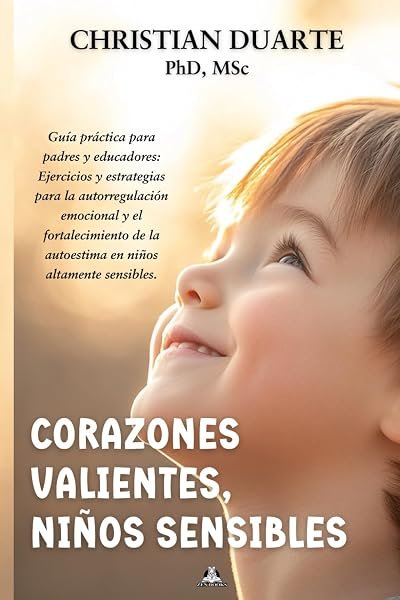 Corazones Valientes
Sources
- Lionetti, F., Aron, A., Aron, E. N., Burns, G. L., Jagiellowicz, J. and Pluess, M. (2018). Dandelions, tulips and orchids: evidence for the existence of low-sensitive, medium-sensitive and high-sensitive individuals. Translational Psychiatry, 8, 24.
- Ellis, B. J. and Boyce, W. T. (2008). Biological sensitivity to context. Current Directions in Psychological Science, 17(3), 183-187.
- Pluess, M. and Boniwell, I. (2015). Sensory-Processing Sensitivity predicts treatment response to a school-based depression prevention program: Evidence of Vantage Sensitivity. Personality and Individual Differences, 82, 40-45.